
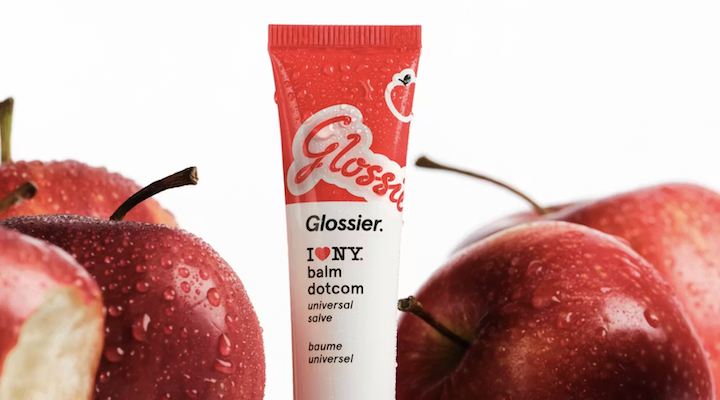
Rather than chasing the next viral trend, Glossier is looking to its origins. The beauty brand’s latest campaign pairs limited-edition “I heart NY” merchandise with Manhattan bodega activations and partnerships with local businesses, all designed to reinforce the New York identity that once set it apart. The strategy reflects a broader effort to rebuild the brand by rediscovering what made consumers fall in love with it in the first place. After reaching a peak valuation of US$1.8 billion
on in July 2021, Glossier has spent recent years shutting down three-fourths of its brick-and-mortar presence while cycling through a revolving door of executives. Under CEO Colin Walsh, though, who took the helm in October 2025, its turnaround is increasingly centred on the brand’s heritage through streamlined store operations, strategic product development and a renewed focus on storytelling.
The latest expression of that strategy comes from CMO Nicole Solórzano, who joined the company in April after previously serving at Ouai. The campaign centres on a limited-edition Balm Dotcom featuring the iconic “I heart NY” logo alongside a symbolic apple. It is accompanied by exclusive merchandise, including a keychain, T-shirt, sticker pack and a baseball cap available only at Glossier’s SoHo store.
The New York theme extends beyond the product launch. Ten bodegas throughout Manhattan will be stocked with a limited number of the balms, while the brand’s New York flagship store will be transformed into a “balmdega,” offering apple juice and candied apples to shoppers throughout the summer. Glossier is also partnering with several New York-based businesses, including La Cabra and Ha’s Snack Bar, to host related activations.
Can Glossier win back millennial shoppers?
Solórzano said the campaign pays tribute not only to the city where the brand was born, but also to the storytelling that helped shape the brand’s identity.
“Long before Glossier became a beauty brand, it was a beauty-dedicated editorial site called Into the Gloss, about real women and the routines they actually kept. Born in New York City, inspired by its people and shaped by its energy, Glossier has always reflected the spirit of the city it calls home,” said Solórzano.
Retail brand strategist and marketing consultant Bethany Paris Ramsay believes Glossier’s return to its origin story is a smart move.
“People fell in love with Glossier because it felt like they were part of a cultural moment. The brand was a status symbol that said ‘cool girl’,” explained Ramsay.
She argued that reconnecting with New York City, Into the Gloss and the people who shaped the brand reminds consumers why they cared in the first place, adding that heritage has become a competitive advantage in beauty – provided it feels authentic rather than nostalgic.
“Leaning back into New York City, Into the Gloss, and the people who originally shaped the brand reminds consumers why they cared in the first place. That’s especially important right now because beauty is entering an era where taste and cultural credibility matter more than endless product launches. Heritage has become a competitive advantage, but only if it’s presented as something living rather than nostalgic.”
That strategy extends beyond marketing. Glossier has also brought back Alexis Page, the product developer behind several of its original hero products, as a consultant.
“Consumers have become incredibly savvy about who is actually behind the products they love,” Ramsay said, arguing that Page’s return reinforces authenticity following criticism of the brand’s reformulations. “Bringing back someone associated with Glossier’s original product philosophy, especially after the backlash surrounding reformulations, reinforces authenticity and demonstrates that the brand is listening in a way a marketing campaign alone never could.”
But Ramsay warned that nostalgia alone won’t secure Glossier’s comeback. The brand, she argued, must build on its original strengths while continuing to evolve with the beauty industry.
“Many of us working in DTC would simply love a time machine back to 2016, trust me, but we’re in 2026. The biggest opportunity for Glossier is proving it still understands where beauty culture is headed. That means continuing to invest in thoughtful product innovation, giving emerging voices space alongside the originals, and creating experiences that feel genuinely participatory rather than simply referential.”
“Brands have to evolve without losing the qualities that made people care in the first place,” she added. “For Glossier, rediscovering that cultural confidence will end up being far more valuable than chasing the next viral product.”
Glossier doesn’t need to reinvent itself
Like Ramsay, Kimber Maderazzo, professor of marketing at Pepperdine Graziadio Business School and a beauty industry expert, pointed to Glossier’s legacy as a generation-defining brand.
“Glossier was the ultimate millennial beauty brand. In many ways, it defined the aesthetic of an entire generation,” said Maderazzo. “It even inspired what many people now refer to as ‘millennial pink.’ The challenge is that the customer who helped build the brand has evolved. Millennials are now in a different stage of life, with different skincare concerns, beauty priorities and purchasing behaviours than they had a decade ago.”
While Maderazzo commended the brand for highlighting its heritage through its latest marketing and product initiatives, she noted that nostalgia alone rarely helps a brand create sustained growth.
“The bigger question is whether that message resonates with today’s younger consumers, who didn’t experience Glossier’s rise firsthand. I’m not convinced it will. The digital landscape is dramatically different today than it was during Glossier’s peak. Organic community building is far more difficult, social platforms are more fragmented and consumers have countless beauty brands competing for their attention.”
Rather than trying to recreate the past, Maderazzo suggested that the brand should evolve its messaging to reflect the realities of the millennial customer today. That includes speaking to changing skincare needs and the busy lifestyles and priorities of consumers at this stage of life. “The brand doesn’t need to reinvent itself. It needs to acknowledge that its customer has grown up. If Glossier can combine the authenticity that made it iconic with messaging and innovation that are relevant to today’s millennial consumer, it has a stronger opportunity for a meaningful comeback than simply revisiting its origins.”
Further reading: As Glossier loses multiple senior leaders, experts analyse the brand’s future