Lanvin Group has finally made its cost cuts outrun its revenue decline. The Shanghai-based luxury company posted revenue of €100.8 million for the six months to June 30, down 12.9 per cent against a prior-year base restated to exclude Caruso, the Italian tailoring house sold in February. Adjusted EBITDA came in at minus €34.6 million, against minus €52.2 million a year earlier. Losses narrowed by roughly €17.6 million while revenue fell by about €15 million. For the first time si
ime since the group’s 2022 listing on the New York Stock Exchange, the cost program has moved faster than the top line has eroded.
“The first half represented an encouraging step forward for the group,” Zhen Huang, chairman of Lanvin Group, said. “Supported by renewed creative and executive leadership across our houses, we are confident in our ability to progressively unlock the long-term potential of our brands amid market challenges.”
Four brands, four speeds
St John is now the group’s largest brand, and the one management can point to without qualification. Revenue was €35.5 million, down 10.5 per cent in euros but only about 5 per cent in US dollars. E-commerce grew 31 per cent. Mandy West, promoted from chief commercial officer in March, has two capsule collections scheduled for the second half.
Wolford delivered €31.0 million, down 6 per cent, the portfolio’s shallowest decline. Direct-to-consumer fell 2 per cent, like-for-like retail stayed positive, and e-commerce grew 22 per cent. Gross margin was up from 56 to 60 per cent as the supply problems that disrupted the Austrian brand last year cleared. Marco Pozzo, appointed in February, inherits a business that has stopped deteriorating.
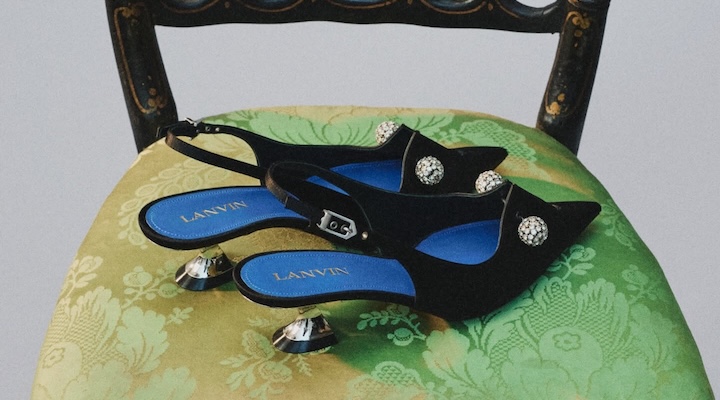
Lanvin itself generated €22.9 million, down 17.9 per cent, which makes the group’s namesake maison its third-largest brand by revenue. Peter Copping’s winter 2026 show in Paris gave the house its first coherent women’s ready-to-wear proposition in years. Barbara Werschine, formerly of Hermès and Eric Bompard arrived as chief executive in May with a remit that extends into menswear and, eventually, home and lifestyle. On an annualised basis, the maison turns over roughly €46 million, which is not enough to carry a listed group.
Sergio Rossi remains the problem. Revenue fell 28.6 per cent to €10.9 million as the brand shifts toward a licensing-led model and deliberately winds down third-party production, costing €1.9 million in the half. Wholesale excluding that production work grew 21 per cent, which management reads as renewed partner interest. Gross margin was squeezed by clearance activity, channel mix and an unfinished supply chain transition. The brand also lost artistic director Paul Andrew in January, less than 18 months into the job.
The cost base can’t be ignored
Directly operated stores fell from 174 at the end of 2025 to 151 by June, 23 closures in six months. Taken with last year’s reductions, the network has gone from 225 to 151 in 18 months, a third of the estate. Because like-for-like sales stayed positive at Lanvin and Wolford boutiques, most of the revenue decline is self-inflicted rather than demand-driven. That reading holds for a half or two. It gets harder once investors start asking where the floor sits.
What comes next
The group said it is continuing to optimise its brand portfolio. Caruso went to Abu Dhabi-backed MondeVita in February. Sergio Rossi is being reshaped around licensing. Lanvin is to deepen asset-light partnerships.
Greater China accounted for 8.1 per cent of group revenue last year. Management expects the current transformation program to be largely complete this year. Huang said the group remains confident of unlocking its brands’ long-term potential. The cost work has bought credibility and, more usefully, time. The first half showed Lanvin Group can stop losing money quickly. The second has to show it can sell something.
Further reading: What Lanvin Group’s FY2025 numbers actually tell us.