
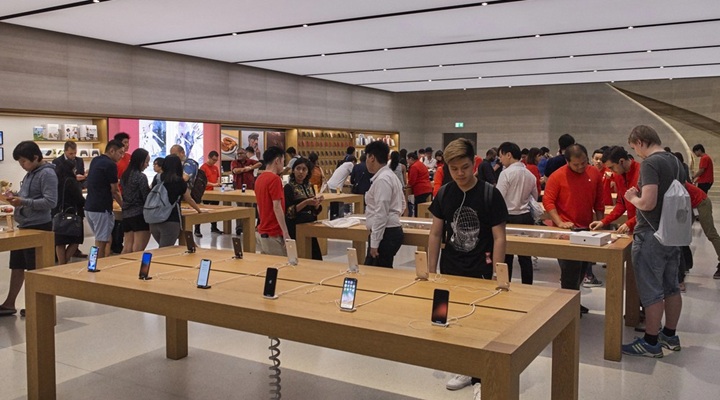
Singapore retail sales growth accelerated in September, driven by higher demand for mobile phones and elevated petrol prices.
According to the Department of Statistics, retail sales (excluding motor vehicles, parts and accessories) increased 2.5 per cent, compared to the revised 1.7 per cent growth in August.
The estimated total retail sales value was SG$3.6 billion (US$2.8 billion), of which 20.8 per cent were from online.
Retailers of the computer and telecommunications equipment sector posted the strongest year-on-year increase of 16.5 per cent, mainly due to higher mobile phone sales. Petrol service stations followed with a 6.5 per cent growth, as petrol prices increased during the month.
Sales also rose 6 per cent in the cosmetics, toiletries and medical goods sectors, and 5.3 per cent in furniture and household equipment.
In contrast, mini-marts and convenience stores recorded a sales drop of 5.6 per cent, followed by department stores at 3.4 per cent.
Sales of food and beverage services increased 1 per cent in September, reversing the 1.8 per cent decline in August.
Haze impacted physical stores
Despite the solid year-on-year growth, September’s retail sales decreased 1.8 per cent compared to August.
Zavier Wong, market analyst at Etoro, said the haze situation was the likeliest reason for the drag.
“September was the first time since 2019 that air quality turned unhealthy across the island. Put simply, consumers will avoid wandering through the streets in those conditions as much as possible. The effects are most prominent across physical stores such as mini-marts, recreational goods, optical goods and books,” Wong said.
He noted that the computer and telecom equipment sector was able to surpass the weakness in physical stores thanks to the launch of Apple’s new iPhones. However, this bump is unlikely to repeat in October.
Wong expects similar retail sales patterns in October, given the haze lasted through much of the month.
“I’d expect the next print to look a lot like September’s, with physical stores soft and online busy.
“The annual rate won’t get much help from the headline either, because last year’s October and November both grew above 4 per cent, which leaves a high base to climb over,” the analyst said.