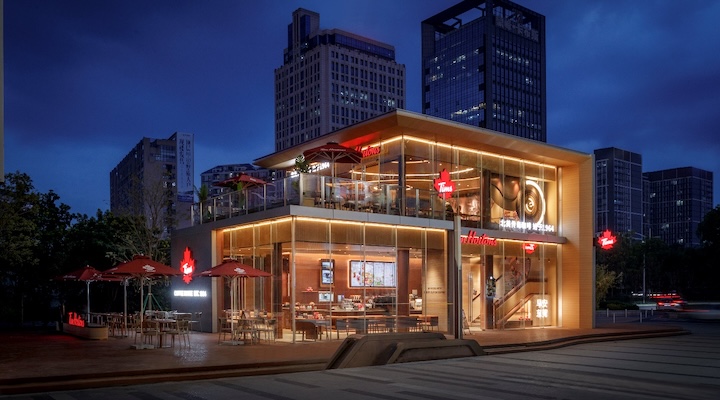
Tims China has sold coffee to far fewer people in the three months to June. For much of last year, China’s delivery apps were paying customers to order. This year they stopped, and the traffic left with them. Revenue for the quarter fell 21.7 per cent year on year to RMB273.4 million (US$40.3 million) with same-store sales at company-operated stores down 17.3 per cent. Kwok Wah Cheung, the new CEO of Tims China’s parent TH International, called the second quarter a “period of transition”
” for the business. “Our top-line results were impacted by our proactive decision to close underperforming stores, as well as pressure on same-store sales as we lapped strong delivery performance from last year,” he said.
The delivery aftermath
Orders at company-run stores fell to 8.3 million from 10.5 million. Delivery now accounts for 65.7 per cent of company-run store revenue, up from 61.0 per cent. Meanwhile, delivery orders fell 11.9 per cent, to 7.2 million, against a 20.7 per cent fall in orders overall.
Chief financial officer Dong (Albert) Li was direct about the cause. “The decline came partly due to the delivery aggregators backing down their subsidies significantly,” he said, “and also partly due to our underspend in marketing and advertising spending and also a certain discount control.”
China’s market regulator moved against those subsidies in June, issuing draft rules that bar platforms from running large, long-running discount campaigns funded out of their own capital. Meituan, Alibaba and JD.com had spent a year buying orders. Chains that leaned on that money are now finding out how much of their custom was rented.
Over 37 million members, 2.85 million customers
Tims China’s loyalty club membership reached 37.1 million at 30 June, up 41.7 per cent, or more than 36,000 per store. Cheung called it “green shoots … providing a strong foundation to deepen customer engagement and support future growth”.
But sign-ups and sales have come apart. Membership rose 42 per cent while customers fell by a fifth, suggesting people are joining for a discount, not coming back for the coffee.
Cheung’s priorities are better products, stronger marketing, better service, and new stores concentrated in big cities, office districts and transport hubs. “Our imperative is to get back to our business fundamentals to regain customers and to gain new users,” he said, pointing to bagels, milk-based coffee and the quiet afternoon trade.
Franchised stores rose to 484 from 449 over the year while company-run stores fell to 544 from 566, and new openings will be split evenly between the two.
The difficulty is size. Luckin Coffee reported revenue of RMB15.89 billion in the same quarter, up 28.5 per cent, and 112.7 million monthly customers, which is about 58 times Tims China’s revenue and 40 times its customer base. Cotti has passed 18,000 stores. Starbucks China’s venture with Boyu Capital closed in April with a 20,000-store target. Tea chains such as Mixue and Guming are moving into coffee. Tims China opened a net two stores.
“We have to offer the best value to our customers, and value is delivered through the combination of product, experience and also pricing,” Cheung said. He says all cylinders are firing now, but would not say when that should show up in the numbers.
“For the time being, I can’t share with you a particular timeline. Hope you can bear with us.”
At the current rate of loss, the new money buys him closer to a year than two.