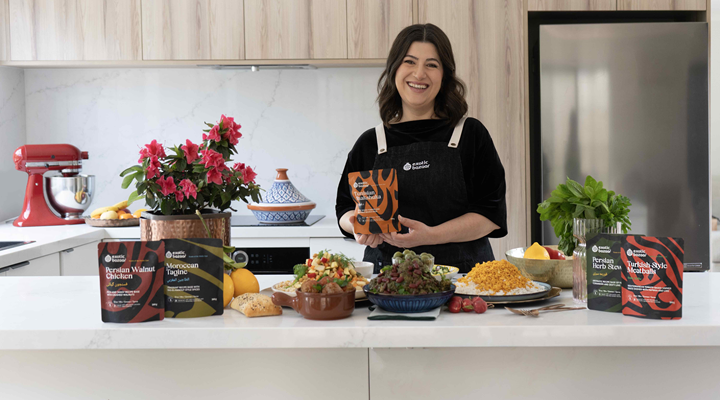
Before people understand a culture through language, history, politics or travel, they often meet it through food. It might begin with a question. What is this spice? How do you make this? Is this what you grew up eating? That has always stayed with me, because food is one of the gentlest entry points we have. It can make the unfamiliar feel welcoming. I founded Exotic Bazaar in Ballarat around Persian and Middle Eastern flavours I grew up with. What began with meal bases and spice blends soon r
soon raised a question – how do you make heritage food feel approachable without sanding away what makes it distinctive?
It started with lunch
Years ago, before I started Exotic Bazaar, I worked as an IT data analyst and used to bring homemade Iranian food to work for lunch. Someone would ask what I had brought. Someone else would taste it. Then came the questions about the spices, the rice, the stews, the names of the dishes and the way things were served. Nobody was trying to have a formal conversation about culture, but the food made people curious, and once people were curious, the conversation followed.
Australians hardly need much persuading to be curious. A 2025 Taste.com.au survey of more than 2300 people found that more than 60 per cent wanted to experiment with global flavours, while most home cooks were already preparing meals from at least three cuisines each week. The appetite is there; however, the real work for food brands is making something unfamiliar feel easy enough to cook after work on a Tuesday.
I wanted to make Middle Eastern-inspired cooking feel achievable on an ordinary weeknight, with meals that could come together in about 30 minutes and required only a few fresh ingredients.
Is it spicy?
At farmers markets, I learned very quickly that most people were not asking whether Middle Eastern food was interesting – they already thought it was. The questions were much more practical. What do I add to it? Is it spicy? How long does it take? Will my children eat it? Do I need special ingredients? Can I make it vegetarian? What does it taste like once it is cooked?
People wanted to try something new, but they needed to feel confident it would work in their own kitchen, with their own family, on an ordinary weeknight.
Some products connected more quickly than others. Shakshuka, for example, had become more familiar through cafes and brunch menus, so people understood the idea faster. Moroccan Tagine felt warm, colourful and recognisable, even for shoppers who had never cooked it before. Persian Walnut Chicken needed more explanation because it was less familiar, but once people understood the story and flavour behind it, they were often intrigued.
That taught us an important lesson about product development – a dish name can invite curiosity, but it can also create distance if the customer cannot quickly understand what the product is, how to use it and what kind of meal it will become.
This became even more important as Exotic Bazaar moved from farmers markets into selected Coles stores nationally in Australia.
When nobody is there to explain
At a farmers market, I could stand in front of people and explain every dish. I could tell them what to add, how it should taste, what my family would serve it with and why it mattered. In Coles, the product has to do much of that work on its own.
The packaging has to invite people in. The instructions have to build confidence. The product name has to feel interesting without feeling confusing. The format has to make sense quickly. The customer needs to understand not only what the product is, but why it belongs in their life.
After proving that people connected with the food, our first major investment was changing the packaging and shaping the range into something more supermarket-friendly. We brought in professional designers, photographers and marketing support because we knew the products had to speak clearly on shelf.
Supermarket buyers need to see this, too. Passion and purpose matter, but they are not enough on their own. A buyer also needs to understand where the product sits in the category, who the customer is, how clearly it communicates on shelf, whether the pricing works, whether supply can be consistent and whether the product brings something new without making the shopping experience harder.
Visibility matters
For a small founder-led brand, being in selected Coles stores nationally was a major business milestone. It was also emotional. It meant Middle Eastern flavours and stories were no longer sitting only in specialty shops, markets or restaurant menus. They were sitting in everyday Australian shopping baskets.
From culture to category
When someone cooks Persian Walnut Chicken, Moroccan Tagine or Tunisian Shakshuka at home for the first time, they are not just buying dinner – they are bringing a new flavour profile into their household. They are learning a dish name and are serving something their family may not have grown up with. If they enjoy it, they may cook it again and over time, it becomes less foreign and more familiar.
There is always a balance between making food accessible and flattening it into something generic. The answer, I believe, is not to make everything safe or remove the story. It is to explain the product clearly, make it practical and keep enough of the cultural identity that the customer feels they are discovering something real.
A culturally inspired food product needs to answer several questions at once: What is it? How do I use it? What do I add? How long will it take? What will it taste like? Is it for a family dinner, a weekend meal, entertaining, baking or gifting?
Australian consumers are already open to food from around the world. We can see it in restaurants, cafes, meal kits, social media, travel and the way people talk about flavour. But there is still room to help more cuisines cross over from something people enjoy outside the home into something they feel confident cooking themselves.
Middle Eastern food, in particular, is loved by many people, but it has not yet become as familiar in everyday home cooking as some other global cuisines. There is still an enormous opportunity for the category to grow, especially if brands can help consumers move from curiosity to confidence.
A meal base will never contain the whole history of a cuisine, but it can open the door to it. Sometimes understanding another culture begins in particularly unceremonial circumstances – with dinner.
Gilava Pour is the founder of specialty food business Exotic Bazaar.
Originally published in the October edition of Inside FMCG.